A gameboy speaker upgrade in 2026 falls into five real categories, and picking the wrong one wastes a mod session. Best overall: a modern mono speaker replacement for any DMG, GBC, GBA, or GBA SP with a dead or rattling stock speaker. Best budget option: an audio capacitor refresh for consoles that still sound muffled with their original caps in place. Best for silent play: a headphone jack line-out tap, available only on the original Game Boy and Game Boy Color.
- Best overall gameboy speaker upgrade in 2026: swap the stock mono speaker for a modern replacement unit.
- Audio capacitor refresh is the cheapest gameboy speaker upgrade fix for hazy, muffled sound.
- GBC and the original DMG Game Boy have headphone jacks; GBA and GBA SP never did.
- Plug-and-play speaker boards skip soldering entirely for a first-mod-friendly upgrade.
- External amp mods add real volume gain but pull more battery current.
Why this matters
Every Game Boy shell on the market in 2026 is at least 22 years old, and the audio hardware inside hasn't aged well. Foam speaker surrounds stiffen, voice coils fatigue, and electrolytic capacitors on the audio path dry out and lose capacitance. The symptom is the same either way — quiet, muffled, or rattling sound — but the fix is completely different depending on which part failed.
GBMake builds custom Game Boy and GBA cartridges and flash burners for the same crowd chasing a clean gameboy speaker upgrade: developers testing homebrew audio and hobbyists who want their hardware sounding as good as it looks. Getting the diagnosis right before you open the shell saves a wasted soldering session.
What makes the best gameboy speaker upgrade
- Solder requirement — some fixes need an iron and steady hands, others don't touch a soldering pad.
- Console compatibility — DMG, GBC, GBA, and GBA SP have different boards, shells, and jack layouts.
- Reversibility — whether the mod can be undone without damaging the board.
- Root-cause match — whether the fix addresses a dying speaker, a degraded signal path, or just low output.
- Skill level — first-mod-friendly versus experienced-modder-only.
Gameboy speaker upgrades at a glance
| Upgrade | Best for | Standout feature | Key limitation |
|---|---|---|---|
| Modern mono speaker replacement | Dead or rattling stock speaker | Drop-in fit on GB/GBC/GBA mounting points | Requires desoldering the old speaker leads |
| Audio capacitor refresh | Hazy or muffled sound | Fixes the signal before it reaches the speaker | Won't help a mechanically blown speaker |
| GBC/DMG headphone jack line-out | Silent headphone play | Uses wiring already on the board | Only exists on DMG and GBC, not GBA/GBA SP |
| Plug-and-play speaker mod board | Zero-soldering builds | No iron required | Fewer placement options inside the shell |
| External amp mod | Maximum volume | Real gain over stock output | Draws more current, shortens runtime |
1. Modern mono speaker replacement: best gameboy speaker upgrade for a dead or rattling speaker
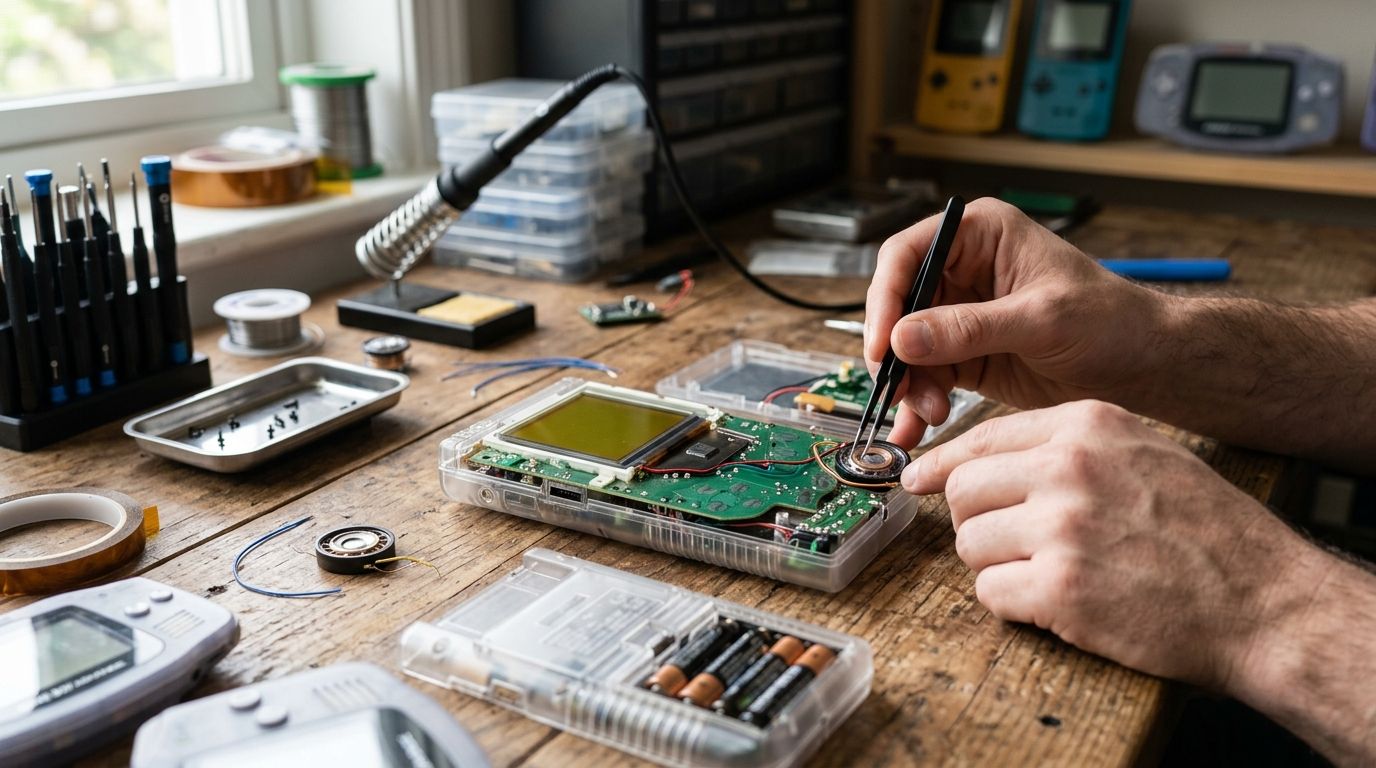
A stock Game Boy speaker is a small mono driver, and it ages like any speaker that age does: the surround stiffens, the coil fatigues, and the cone buzzes at moderate volume. Swapping it for a modern mono replacement removes the mechanical problem instead of working around it.
Modern mono speaker replacement pros:
- Fixes rattling and dead-speaker symptoms nothing else on this list touches
- Fits DMG, GBC, GBA, and GBA SP shells at the stock mounting points
- Pairs cleanly with a capacitor refresh for a full audio pass
Modern mono speaker replacement cons:
- Requires desoldering two leads and basic iron skills
- Won't fix muffled sound caused by aging capacitors on its own
Best for: consoles with a speaker that's cracking, buzzing, or silent at any volume. Verdict: Buy.
2. Audio capacitor refresh: best budget gameboy speaker upgrade for hazy or muffled sound
Electrolytic capacitors on the audio path dry out over decades and lose capacitance, muting the signal before it ever reaches the speaker cone. An audio capacitor refresh replaces those aging caps with fresh ones at the same rated value, restoring the clarity the board had when it left the factory.
Audio capacitor refresh pros:
- Cheapest fix available for hazy or muffled audio
- Works on original DMG, GBC, and GBA boards with original caps still installed
- Doesn't touch the speaker or shell, so it's low-risk
Audio capacitor refresh cons:
- Does nothing for a speaker that's already mechanically dead
- Needs a fine-tip iron near small pads on later boards
Best for: consoles that sound dull or quiet but the speaker still moves cleanly. Verdict: Buy.
“If your speaker rattles at any volume above half, the driver is dying — not the cable.”
3. GBC/DMG headphone jack line-out: best gameboy speaker upgrade for silent headphone play
The original Game Boy and Game Boy Color both shipped with a 3.5mm headphone jack; the Game Boy Advance (2001) and Game Boy Advance SP (2003) dropped it entirely. On DMG and GBC, tapping the existing jack wiring gives clean line-out audio without adding new hardware.
GBC/DMG headphone jack line-out pros:
- Uses wiring already on the board
- Cleaner output than the stock speaker for recording or headphone listening
- No new holes or hardware in the shell
GBC/DMG headphone jack line-out cons:
- Doesn't exist as an option on GBA or GBA SP
- Doesn't improve the internal speaker itself
Best for: DMG or GBC owners testing homebrew audio through headphones. Verdict: Buy for DMG/GBC, Skip for GBA/GBA SP.
4. Plug-and-play speaker mod board: best gameboy speaker upgrade for zero-soldering builds
A plug-and-play speaker mod swaps the internal speaker using a pre-wired board with connectors instead of solder joints — the entry point for anyone who's never opened a Game Boy shell before.
Plug-and-play speaker mod board pros:
- Zero soldering required
- Reversible in minutes
- A good first mod for someone new to Game Boy hardware
Plug-and-play speaker mod board cons:
- Connector housing takes up more room than a soldered speaker
- Fewer speaker size options than a direct swap
Best for: first-time modders who want an upgrade without picking up an iron. Verdict: Buy for beginners, Hold if you already solder comfortably.
5. External amp mod: best gameboy speaker upgrade for maximum volume
An external amp mod adds a small amplifier board between the audio source and the speaker, pushing real gain over the stock output stage. It's the option for players who've already fixed the speaker and capacitors and still want more volume.
External amp mod pros:
- Meaningful volume increase over stock output
- Works alongside a speaker replacement or capacitor refresh
- Useful for GBA and GBA SP owners with no headphone jack option
External amp mod cons:
- Draws more current, shortening battery runtime
- Most complex install on this list, with extra wiring to route
Best for: players who want louder output after every other fix. Verdict: Buy for max-volume builds, Skip if you're just fixing a dead speaker.
How we ranked these gameboy speaker upgrades
Each pick is scored against the same five criteria: solder requirement, console compatibility, reversibility, whether it addresses a mechanical or electrical failure, and skill level. Modern mono speaker replacement ranks first because it's the only fix here that solves a dead or rattling driver directly. Audio capacitor refresh ranks second because it's the cheapest, most universal fix for a different problem entirely — a healthy speaker driven by a dying signal.
Which gameboy speaker upgrade should you choose?
If you're not sure where to start in 2026, replace the speaker first if it rattles or stays silent at any volume — no capacitor refresh fixes a mechanically dead driver. If the speaker still moves but sound is dull, run an audio capacitor refresh before buying new hardware; it's cheaper and it's often the actual cause. DMG and GBC owners chasing clean audio for recording or homebrew testing should tap the headphone jack line-out before touching the internal speaker at all. Whatever you pick, fix the speaker or capacitor path before adding an amp mod in 2026 — amplifying a dying signal just amplifies the problem.
Building a Game Boy audio mod project?
Custom cartridges and flash burners for GB and GBA hobbyists.
FAQ
What's the best gameboy speaker upgrade in 2026?
A modern mono speaker replacement is the best overall gameboy speaker upgrade in 2026 because it fixes dead or rattling speakers directly. Pair it with a capacitor refresh for a full audio pass on older boards.
Is a capacitor refresh worth it before replacing the speaker?
Yes, run it first if the speaker still moves cleanly but sound is dull or quiet. It's cheaper than a speaker swap and is often the actual cause of muffled audio.
Do all Game Boy models have a headphone jack?
No, only the original DMG Game Boy and Game Boy Color have one. The Game Boy Advance (2001) and Game Boy Advance SP (2003) never shipped with a headphone jack.
Can I upgrade a GBA SP speaker without soldering?
Yes, a plug-and-play speaker mod board uses connectors instead of solder joints. It fits GBA SP shells and is reversible in minutes.
Does a louder speaker or amp mod drain the battery faster?
An external amp mod draws more current than stock, which shortens runtime. A speaker swap or capacitor refresh alone doesn't meaningfully change battery life.
Is a speaker swap reversible?
A soldered speaker swap can be undone but requires desoldering skill to reverse cleanly. A plug-and-play speaker mod board is reversible in minutes with no solder involved.
What tools do I need for a Game Boy speaker mod?
A soldered speaker replacement or capacitor refresh needs a fine-tip soldering iron and a Game Boy-specific screwdriver bit. Plug-and-play speaker boards need only the screwdriver.
Does a better speaker improve homebrew game audio?
Yes, a fresh speaker and clean capacitor path reproduce homebrew audio more accurately than a degraded stock setup. Developers testing sound design benefit most from fixing both the speaker and the signal path.
One last thing
Most players assume a quiet Game Boy means a dying speaker, but a dried-out capacitor on the audio path produces the exact same symptom — and it's the cheaper fix by far. Test the capacitor refresh before you buy new speaker hardware in 2026; it solves more "broken speaker" complaints than the speaker itself ever does.